What safety equipment do I need? A boat safety checklist.
Having the right safety equipment aboard your boat can make all the difference when it comes to staying safe on the water. But what do you actually need aboard your vessel?
When it comes to boating, the sea can be your best friend. But when you’re enjoying beautiful blue skies, calm waters, and maybe even a dolphin sighting, it’s easy to forget how dangerous the open water can be. But the seas can turn, and a pleasant boating experience can quickly become a nightmare.
Having the right safety equipment aboard your boat can make all the difference when it comes to staying safe on the water. Whether you’re pottering around inland waterways, taking your fishing boat out to sea, or heading on a coastal cruise in your liveaboard yacht, having things like lifejackets, fire extinguishers, and a radio can be lifesaving when disaster strikes.
But is there anything actually governing what you must take aboard your vessel, or is it all just good sense?
Jump to section:
How are safety requirements classified?
Offshore vs inland waterways
International safety regulations
Vessels under 13.7 metres
Vessels over 13.7 metres but under 24 metres
Vessels 24 metres or more but less than 500GT.
Related Reading

Having the right safety equipment onboard can help prevent your boating dreams from becoming nightmares. Photo by Jason Thompson on Unsplash
Well, depending on the waters you’ll be operating in, different rules apply, and you should always check local regulations before heading out. In the UK, boat safety equipment is primarily governed by the Maritime and Coastguard Agency (MCA), the Royal Yachting Association (RYA), the Boat Safety Scheme (BSS), and the International Convention for the Safety of Life at Sea (SOLAS). You might also find some areas have local regulations and restrictions, so checking safety requirements should always be a part of your passage planning.
How are safety requirements classified?
As a general rule, the safety equipment you need aboard your boat will depend on the size of the ship and the crew. For example, every boat must have enough lifejackets to fit every crew member (plus a couple of spares), and any boat taking children aboard must ensure they’re wearing appropriately fitting lifejackets.
As the size of the boat increases, vessels must be fitted with increasing amounts of safety equipment, and, when you get to the really big boats, safety drills and procedures must also be put in place.
In addition to the size of your boat, where you plan to use her will also dictate what safety equipment you need onboard. For example, a canal boat pottering through an inland river won’t need the same extent of safety equipment as a commercial vessel heading out to sea.

Different sized vessels are required to carry different amounts of safety equipment, but these are all minimums and it’s always a good idea to carry more safety gear than you think you’ll need! Photo credit: Danniel Corbit
As is so often the case with boating, a lot of the rules regarding safety at sea are fairly straightforward and make a lot of sense. And the more safety equipment you can bring with you, the better (remember, these are all minimum standards – you’ll never get in trouble for having more safety gear than you need!).
Offshore vs inland waterways
So, we know that the regulations dictating the safety equipment you must carry on your vessel are generally dictated by the size of the boat and the number of crew aboard, but the rules can also vary depending on the type of water you’ll be using the boat in.
In the UK, the government has four categories of waterways, which are generally distinguished by the depth and the distance from the shore: “inland”, “coastal”, or “offshore” are the three main types of water you’ll deal with.
“Inland waters” include any areas of water that aren’t “sea” and can be classified as one of four categories:
- Category A refers to narrow rivers and canals with a depth less than 1.5 metres.
- Category B refers to wider rivers and canals with a depth of more than 1.5 metres, where the wave height rarely or never exceeds 0.6 metres.
- Category C refers to tidal rivers, estuaries, and large/deep lakes or lochs where the wave height rarely or never exceeds 1.2 metres.
- Category D refers to tidal rivers and estuaries where the wave height rarely or never exceeds 2 metres.
Some rules will only apply to vessels operating in certain classifications of waterways, so you may wish to check with the Maritime & Coastguard Agency to ensure your boat adheres to the rules of the water that you’ll be operating in. If you get a boat survey, the surveyor will also be able to advise you on the level of safety equipment you need for your boat in the waters you plan to operate in.

Boat safety regulations may vary depending on what type of water you’ll be operating your boat in. For example, a narrowboat that spends all its time in inland waters won’t need the same level of safety equipment as a boat that’s heading out to sea.
International safety regulations
To keep everyone safe on the water, the UK follows the International Convention for the Safety of Life at Sea (SOLAS). This international treaty is widely regarded as the most important and concerns the safety of all ships at sea.
SOLAS includes multiple regulations dictating minimum safety standards on the construction, equipment, and operation of ships at sea throughout its 14 chapters. Although not every chapter will apply to personal-use vessels, some do apply, including the following:
- You must plan your voyage and have a destination in mind when setting off.
- You must carry a radar reflector (among other safety equipment).
- You must carry an illustrated table of recognised life-saving signals.
- You must help other craft if you’re required and capable of doing so.
- You must use distress signals properly and appropriately.
Now, let’s take a look at some of the specific safety items you must carry aboard your vessel.
Remember, these are minimum requirements. The more safety equipment you can stow aboard your vessel, the better!
Vessels under 13.7 metres
In the UK, recreational vessels under 13.7 metres (45 feet) are regulated by the Maritime and Coastguard Agency (MCA), who dictate the safety equipment all boats must have aboard. While some of these safety measures will vary depending on the type of waters your boat is operating in, there are some general guidelines that all boats must adhere to.

Boats up to 13.7 metres (or 45 feet), like this 2006 Sealine S25, must adhere to certain rules regarding the safety equipment they should have aboard.
1. Lifejackets
As per the MCA (and general good sense), every boat should have at least one lifejacket for every person onboard (and ideally a few spares). Lifejackets must meet European standards (BS EN 396:1994 or ISO 12402) and should be equipped (at a minimum) with a whistle and light. If there are any children on board, they should each have their own lifejacket of an appropriate size.
Before leaving the dock, the skipper of a boat should ensure everyone knows how to put on their lifejacket. Ideally, everyone should be wearing their lifejacket the entire time they’re aboard the vessel (for children, this becomes a must), but if the lifejacket isn’t being worn (for example, the crew member is below deck), then they must be stowed somewhere easy to access.

Every vessel should carry at least one lifejacket per person onboard. Children’s lifejackets must be appropriately sized for their age/weight. Photo by Ian Wagg on Unsplash
2. Fire extinguishers
Fire can be absolutely catastrophic on a boat, so having fire safety equipment that can tackle any blaze is essential for boats of any size.
For ships under 45 feet, you should have a minimum of one fire extinguisher and, ideally, a fire blanket onboard. Your fire fighting equipment must be serviced regularly and stored in a place that’s easily accessed and close to fire hazards – for example, near the engine, oven, heating, and/or fuel-burning appliances.
Depending on your vessel, you may need to have more than one fire extinguisher. When I had my 28-ft sailing yacht surveyed, I was advised to get two fire extinguishers: one that lives near the engine/galley and one in the v-birth, ready to go should a fire break out while we sleep. The surveyor also specified the size and rating of the fire extinguishers we had to get and wouldn’t sign off on the survey until he’d received confirmation that they had been purchased and were aboard.
3. Sound-signalling devices
Sometimes, boat owners will be in the open water in low visibility, and sea fog can frequently come over faster than anticipated. In these conditions, it’s vital to have some sort of horn, bell, or whistle that can be used to notify other water users of your presence.
Sounds can also have a plethora of other uses at sea. In the UK, the Boating Association has some helpful tips to help you identify what another vessel is trying to communicate with you via sound blasts, as well as some additional information to help you stay safe on the water.

Sea fog can be a significant problem, especially around the UK. When visibility is reduced, having sound signals and lights aboard will dramatically increase your chances of avoiding a collision.
4. Navigation lights
All vessels should be equipped with proper navigation lights. Even if you don’t intend to sail overnight, navigation lights should also be used in low visibility conditions – just like headlights must be installed in a car!
At a minimum, all boats should be equipped with a green starboard light, a red port light, and a white centre light. The lights should be visible from at least one mile away, but the further, the better.
Your vessel should also have an anchor light at its highest point (for sailboats, this will be the top of the mast). The anchor light must be visible 360 degrees and should be switched on whenever the boat is anchored from sunset to sunrise or in reduced visibility. Anchored boats should also display a black anchor ball to signal they’re anchored during the day.
5. Bilge pump or bailer
Having equipment on board to remove water from the boat should feel obvious to any sensible skipper, but it’s actually a requirement for vessels of all sizes. Whether it’s a manual or electric bilge pump or just a bucket or jug, you must have something onboard to help you bail out water should disaster strike.
6. Lifebuoy or throwing line
Should the worst happen and you experience a man overboard, it’s vital that your boat is equipped with a lifebuoy or floating ‘heaving line’ that’s at least 15 metres long. You should throw these items overboard as soon as someone falls, giving you a good marker to find your way back to them and haul them back aboard as quickly as possible.

Lifebuoys and throwing lines are essential kit in the case of a man overboard. Not only do they provide a floatation aid to the person in the water, but they can also be used as a marker to help the boat find their way back to them. Photo by Jude Mack on Unsplash
7. Gas detection and ventilation
If your vessel has an engine or any gas appliances, you must ensure the cabin has proper ventilation and a gas detector capable of detecting carbon monoxide and dioxide. The gas detector should be serviced regularly and installed near the potential gas source(s).
For more tips, check out our other article on gas safety onboard.
8. Radar reflector
All boats should be outfitted with a radar reflector, but this is particularly essential for vessels operating in coastal or busy waters. Radar reflectors are mandatory for vessels capable of travelling for over 12 miles and help prevent collisions at sea.
9. Flares and other visual distress signals
When I first bought my yacht, I was under the impression that you don’t actually need flares on boats under 13.7m, but that if you do carry them, they must be in-date.
However, there seems to be some conflicting information. And when it comes to safety, it’s always better to have more equipment aboard than you think you’ll need.
So, when operating in coastal or offshore waters, you should ensure to have a flare kit aboard that contains (at a minimum):
- 2 red hand flares for use at night.
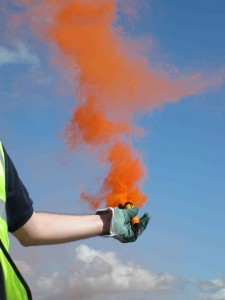
- 2 orange smoke signals for use during the day
10. VHF Radio
Although not required by law for vessels under 45 feet, a VHF marine radio is an essential piece of boating equipment used to communicate with the coastguard, harbour authorities, and other vessels.
It’s a good idea to take a Marine Radio SRC Course and Exam to obtain a radio license and learn how to send and respond to distress calls, as well as how to operate the radio and common radio procedures and protocols. You can visit the RYA website using the link above to find a training centre near you.
In addition to having a radio installed aboard your vessel, skippers should also consider investing in a handheld radio to make communication at sea even easier and more convenient.

Although they’re not mandatory pieces of equipment on smaller vessels, every boat really should be fitted with a VHF marine radio to communicate at sea.
11. EPIRB or PLB
Recreational vessels aren’t legally required to carry these pieces of safety equipment, but an EPIRB (emergency position indication radio beacon) and/or PLB (personal locator beacon) are highly recommended for all vessels operating offshore – even dinghies!
These devices are handheld distress beacons that send a worldwide Search and Rescue alert, helping rescuers pinpoint your exact location and get to you faster. A lot of newer EPIRBs are equipped with AIS technology that instantly notifies nearby vessels that have an AIS receiver of your distress and location, enabling them to start “rescue and recovery operations” immediately without necessarily needing to wait for a response from the coastguard.
12. Anchor and line
Even if you don’t intend to spend any time at anchor, every boat should be equipped with an appropriately sized anchor and length of chain/rope, especially in tidal waters. Ideally, the chain should be at least 5-7 times the depth of the water and strong enough to hold your boat in place.
Even if you’re not planning on anchoring your vessel for long periods of time, you may need to anchor when waiting for a bridge to open, if you misjudge a tidal entrance, or if you’ve sent a distress signal and need to wait for help to arrive.

Boats of all sizes should be equipped with an appropriately sized anchor and sufficient chain/warp to be able to anchor in any waters. Image credit PSCopywriting
13. First Aid Kit
There aren’t many regulations that dictate what must be in your first aid kit, but having one that’s well-stocked and easily accessible is essential for all boats. As some guidance, you may wish to include:
- A selection of bandages, dressings, and gauze.
- Antiseptic wipes and other cleaning supplies.
- Pain relief tablets and antihistamines.
- Medication – including medication for sea sickness, indigestion, diarrhoea, and allergies.
- Sun cream
- Scissors
- Gloves
Your first aid kit should be stored in a watertight, light, robust box and stowed somewhere that’s easy to get to should it be needed. It’s important to keep the kit and its contents clean and free from humidity, dust, salt, and other things that might compromise the equipment.
Summary of safety equipment required for boats under 13.7m (or 45 feet)
| Safety equipment | Requirement? |
| Lifejackets | Yes, at least one per person rated ISO 12402 or higher. |
| Fire extinguishers | Yes, at least one per vessel that has an engine, cooking, heating, or other fuel-burning appliance. |
| Sound signals | Yes, at least one horn, bell, or whistle (I’d recommend some sort of horn) |
| Navigation lights | Yes, a red port light, green starboard light, and white centre light for travelling in low visibility. Lights should be visible for at least one mile. |
| Bilge pump or bailer | Yes |
| Anchor and line | Yes, appropriately sized for the vessel with a chain/line at least 5-7 times the depth of the water. |
| Lifebuoy and/or throwing line | Yes, with at least 15m of line. |
| Gas detection and ventilation | Yes, serviced regularly |
| Radar reflector | Yes, installed at a high point on the boat |
| Flares and visual beacons | At a minimum, boats should carry 2 red hand flares and 2 orange smoke flares, but you may wish to add more types of flares for different occasions as required. All flares MUST be in-date. |
| VHF marine radio | Highly recommended and regularly used to communicate with the coastguard, harbours, marinas, and other vessels, as well as for sending and responding to distress signals. |
| EPIRB and/or PLB | Strongly recommended, especially for offshore passages. |
| Charts and compass | Recommended |
| Towing line | Recommended |
Vessels over 13.7 metres but under 24 metres
As you might expect, the bigger the boat, the more safety equipment you’re required to carry. Boats in this size class will need to carry all the same equipment as smaller vessels, plus some additional kit which may vary depending on the type of water you’ll be operating in (inland, coastal, or offshore).

Boats over 45 feet, like this Jeanneau 51, need some additional safety equipment onboard to ensure a safe experience for all crew and passengers.
1. Life rafts
If you intend to navigate coastal or offshore waters, larger vessels must carry at least one life raft that can accommodate all crew and passengers aboard. The life raft must be approved by the MCA and stored somewhere it can be launched easily.
It’s worth remembering that a life raft, despite being a life-saving piece of kit, should only be deployed as a last resort. If you’re not stepping up onto the life raft, you should stay aboard your primary vessel for as long as possible.
2. Fire extinguishers
Vessels over 13.7 metres must carry a minimum of two fire extinguishers, depending on the ship’s layout. These must be in-date, regularly serviced, and easily accessible.
If your boat has an engine compartment or cooking appliances, you may be required to install an automatic fire suppression system. You will also need to ensure you have extinguishers capable of fighting different types of fire – for example, electrical fires.

Boats over 45-feet need to have at least two fire extinguishers onboard at all times. Photo by Jandira Sonnendeck on Unsplash
3. Sound signalling devices
In addition to the bell, whistle, or horn that smaller boats must carry, boats over 12 metres are also required to install a bell.
4. Flares and visual distress signals
Any vessel over 45 feet that intends to operate in coastal and offshore waters must carry an approved and in-date flare pack including two orange smoke flares and four red hand flares at a minimum.
5. Navigation lights and day shapes
Like smaller boats, those over 13.7m must be fitted with navigation lights (red, green, and white) plus a stern light. All lights must comply with COLREGs and be visible from at least two miles away.
In addition to lights, larger vessels must include day shapes, which are additional visual signals that tell other water users what your boat is doing. They’re usually black geometric shapes, such as balls, cones, diamonds, and cylinders.
The most common shape you’ll spot is a black ball hung from the mast or rigging of an anchored boat.

Anchor balls are a common sight in UK anchorages. These black circular shapes hung from the mast or rigging let other vessels know your boat is anchored during the day when your anchor light can’t be sean.
6. VHF marine radio
A VHF marine radio with Digital Selective Calling is required for boats over 13.7m in order to communicate with the coastguard, harbour authorities, and other vessels.
In offshore waters, vessels in this size class are also required to carry an EPIRB or PLB.
7. Lifebuoys and throwing devices
In addition to what’s required for boats under 13.7m, larger vessels must have at least one lifebuoy aboard that’s been fitted with a floating light. Depending on the size of your boat and its intended use, you may also be required to carry a lifebuoy with a smoke signal.
8. Emergency steering and tiller
In case of steering failure, larger vessels must carry emergency steering gear or a tiller to ensure they’re able to continue steering the boat even when things go wrong.

Ships over 45-feet, like this Swan 58, need to carry some sort of back-up steering system in case there is any steering failure.
9. Charts, compass, and navigation equipment
Recommended for smaller boats, those in the bigger size class must carry up-to-date nautical charts in addition to a working magnetic compass (see also: Is my compass accurate?) and other navigation aids, such as a GPS, echo sounder, or similar.
Even if your vessel is fitted with electronic navigation systems, you will still be required to carry paper charts until they are discontinued in 2030 (expected).
10. First aid kit and emergency medical supplies
In order to keep crew and passengers safe, boats must carry a comprehensive marine first aid kit as well as emergency medical supplies appropriate for the number of persons aboard and the voyage’s distance from shore. This kit should also include a first aid manual for mariners.
11. Man Overboard Equipment
Man Overboard (MOB) equipment and/or recovery systems must be in place on larger vessels. This may include life rings, retrieval systems, rescue ladders, etc.
It’s also highly recommended to carry a Man Overboard alarm or an automatic MOB detection system, especially on longer or overnight passages.
<Vessels 24 metres or more but less than 500GT.
The next size class for safety measures aboard a boat is vessels over 24 metres but under 500GT. For this size class, boats must be fitted with all the above safety equipment (with enough of specific items – such as lifejackets and life rafts – to fit the entire crew and any passengers), plus the following:

Once you exceed 24 metres LOA, like this Damen Custom, there are some additional safety requirements you must adhere to. If you’re using the boat for commercial purposes, these requirements will be even greater.
1. Lifeboats
Large vessels must carry sufficient lifeboats or life rafts to contain the entire crew should the worst happen.
2. EPIRBs
No longer a recommendation, once you get to boats 24m and above, carrying EPIRBs becomes a necessity.
3. Fire-fighting equipment
Vessels in this size class must carry more firefighting equipment, including at least four multipurpose fire extinguishers with a fire rating of at least 13A/113B. They might also be required to install enhanced fire suppression systems, including both fixed and portable systems.
4. Navigation lights
In addition to the usual red, green, and white navigation lights all boats must be fitted with, large vessels may also be required to install additional lights to communicate their activities/intentions and direction of travel.
5. Lifejackets
All boats should carry sufficient lifejackets for every passenger and member of crew, but large ships may also need to carry specialised lifejackets for particular activities. For example, crew working on deck may need an inflatable harness lifejacket, which has additional safety features and also allows for greater freedom of movement.
6. Safety management systems and safety drills
Depending on the size and purpose of the vessel, formal safety management systems (complying with maritime regulations) may need to be implemented. Large crafts may also be required to complete regular safety drills, including ‘abandon ship’ and fire drills to ensure the entire crew knows what to do in an emergency.
7. Man Overboard equipment
The Man Overboard (MOB) kit required by vessels of this size will exceed the requirements of smaller craft. This usually includes equipment such as buoys, lights, and recovery devices. MOB drills should also be completed regularly.

A man overboard is stressful enough when you fall out of a kayak! But when you’re travelling in boats over 24 metres, it’s even more essential to have effective procedures should the worst happen. Photo by Documerica on Unsplash
<Related Reading
Ready to get out on the water and start exploring? We have a plethora of boats for sale at boats.com of all shapes and sizes. Don’t forget to check the safety equipment that comes with the boat to ensure you adhere to SOLAS regulations and stay safe at sea!
For more tips on keeping yourself safe on the water, check out some of our other articles:
- 14 tips to make sure your safety gear is in order
- Lifejackets for children: a buyer’s guide
- How to prepare a boat for offshore sailing
- Rules of the Water and the give-way hierarchy
- 10 emergency fix-it essentials to carry on every boat
- Fixing your engine at sea: emergency top tips