Hunter 49
Contact Seller
XPresented For Sale By:
| Make | Hunter |
|---|---|
| Model | 49 |
| Year | 2008 |
| Condition | Used |
| Price | €189,000 |
| Type | Sail |
| Class | Cruiser (Sail) |
| Length | 48 ft / 14.58 m |
| Fuel Type | Diesel |
| Hull Material | Fibreglass |
| Location | valencia, Valencia, Spain |
| Tax Status | Tax Paid |
| LOA | 49 ft 11 in / 15.21 m |
|---|---|
| Length at Water Line | 43 ft 10 in / 13.36 m |
| Beam | 14 ft 9 in / 4.5 m |
| Max Draft | 5 ft 6 in / 1.68 m |
| Keel Type | Other |
| Ballast | 5690 kg |
| Dry Weight | 14883.73 kg |
| Cabin Headroom | 6 ft 9 in / 2.06 m |
| Engine Type | Inboard |
|---|---|
| Engine Make | yanmar |
| Fuel Type | Diesel |
| Engine Year | 2008 |
| Power | 110 hp |
| Engine Location | Starboard |
| Propeller Type | 4 Blade |
| Propeller Material | Bronze |
| Engine usage (hours) | 1500 |
| Covers |
|
|---|---|
| Electrical Equipment |
|
| Electronics |
|
| Inside Equipment |
|
| Outside Equipment/Extras |
|
| Sails |
|
| Builder | Hunter Marine |
|---|---|
| Guest Heads | 2 |
| Fuel Tanks | 567.81 litres |
| Fresh Water Tanks | 757.08 litres |
| Holding Tanks | 196.84 litres |
| Hull Shape | Monohull |
| Windlass | Electric Windlass |
| Hull Warranty | None |
Description
The Hunter 49 exists as a kind of milestone for chief designer Glenn Henderson. Since joining Hunter in 1998, he has redesigned the entire line of the company's auxiliary sailboats. By replacing the Hunter 46 (introduced in 1997; over 250 built) with the new 49, Henderson and Hunter's engineers have achieved a hull shape that promotes performance, an interior with enough volume to satisfy even the most space-hungry owner, and a versatile design that makes sense both under sail and at anchor.
Hunter offers several sail plan options for the 49. You can choose from one of three mainsail configurations: conventional mainsail with horizontal battens (777 square feet), roller furling mainsail with vertical battens (569 square feet), or roller furling mainsail with partial-length vertical battens (621 square feet). Any of these can be combined with a self-tacking jib (412 square feet) or a 110 percent overlapping jib (489 square feet). A self-tacking staysail (206 square feet) can be combined with any of the jibs. (The prototype -Hull No. 1- that sailed PS carried the 621 square foot mainsail with the overlapping jib and the self-tacking staysail. According to Steve Pettingill, Hunters' offshore testing director, the emphasis behind this plurality of options is efficient sail handling, all of which is based on a reasonably large mainsail and relatively small headsails.
Hunter's literature lists the displacement of this boat in dry weight at 32,813 pounds. Because it is almost certain that those who buy this boat will significantly weigh it down with additional comforts (that figure does not include the considerable weight of an air conditioning system, a combined washer-dryer unit, a generator, or the 350 gallons of fuel and water that can be stored on board), we believe that most owners will prefer to have as much sail area as possible. Anticipating this, Hunter now offers a tall rig option that increases the area of a roller furling mainsail to 662 square feet.
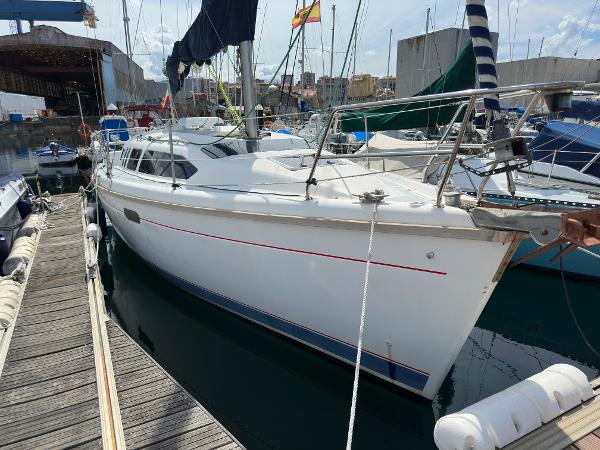
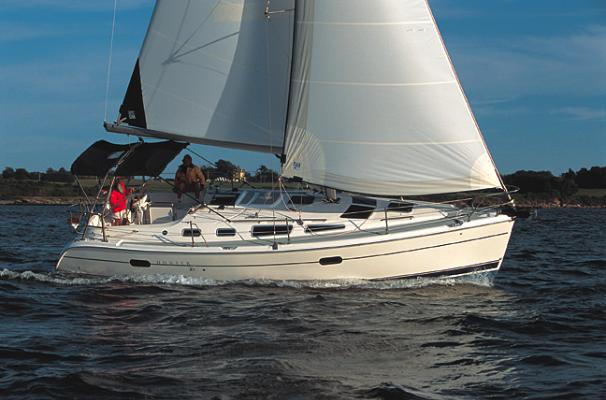
The bow of the 49 was tensioned with a relatively fine entry. This gives the boat a better attitude for sailing or navigating through waves and swells. Despite all the added volume, the profile of the 49 remains surprisingly sleek. Its subtly inverted pure line, combined with a low-profile cabin and reasonably sized portlights, presents an aesthetic package that looks more custom than production-built.
The maximum beam of this boat (14 feet, 9 inches) is approximately 60 percent aft, and much of that width is carried up to the transom.
A stepped two-spreader mast on deck from Selden comprises most of the B&R fractional rig 9/10, which stands at 63 feet and 4 inches above the water. Whether you choose a mast furling or standard rig with a slab mainsail, there is no backstay, so the shrouds are placed far enough aft to give the spreaders a 28-degree aft sweep. The boat we tested had an inner forestay equipped with a new model Harken furler.
There are two keel options for the 49, a deep draft wing keel version (7 feet) or a shoal draft wing keel version (5 feet, 6 inches), which we sailed. The wings are located 12 inches above the deepest point of the keel to reduce the possibility of snagging.
DECK LAYOUT
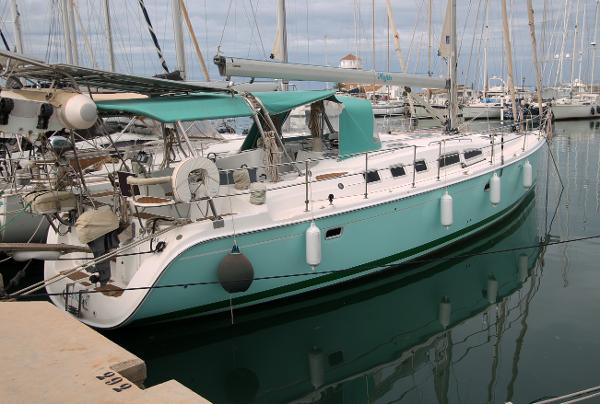
Starting at the stern, the design of the 49 incorporates a T-shaped cockpit that features twin helm stations and a centerline island table made of stainless steel, fiberglass, and Corian. Hunter's signature arch spans the full width of this space and provides not only a base for the mainsheet traveler but also an anchoring point for the optional two-part bimini that covers the entire cockpit and a mounting location for the stereo and speaker housing.
The space behind each wheel (36-inch stainless steel Lewmar models) leaves only 17 inches to the transom, but we found it sufficient to stand at the helm or move around. The tight spaces allow drivers to prepare more easily while steering. And if periods at the helm become tiring, each station has a wraparound seat.
However, in our opinion, the ergonomics of this control station need refinement. On our test boat, someone sitting at the port helm tended to hit the autopilot buttons with their left knee, but Hunter says this will be addressed in the next 49s. And the throttle protrudes too much in the passageway from bow to stern between the port helm and the table. Pettingill assured us that this would also be addressed in future models. This is also important because the throttle is electronic (not mechanical) and was mounted too close to the helm compass on the boat we tested.
The primary winches on either side of the cockpit (Lewmar 54) are within reach of the person at the helm. The furling lines of both headsails are led to nearby cleats; the sheets are handled by self-tailing winches. Hunter has cleverly installed a double-ended mainsheet so that adjustments can be made from the bridge deck or from the port helm station, which has a dedicated Lewmar 54 winch and a Spinlock line clutch at the ready. The mainsail traveler controls are led from above to the turning cleats mounted on the arch supports. These are also within easy reach of the helm stations.
The central opening in the transom leads to a narrow swim platform and a folding boarding ladder. The stainless steel and King Starboard hinged doors that hang here may seem superfluous, but Pettingill explained that they will prevent small items from sliding or bouncing out of the opening. On either side of the transom, a large Bomar hatch (each with four dogs for added security) has been mounted to allow easy access to the mechanical components of the Lewmar Mamba rack and pinion steering system located below.
The cockpit offers ample storage space in six different compartments surrounding the helm stations. The two lockers beneath the cockpit seats are large enough to accommodate a liferaft in a bag or other bulky items like sails. The cockpit seats are long enough for a person to lie down fully (74 inches). Although Hunter has used Flexiteek in many places, such as the small molded step in the coaming, most of the deck is standard non-skid with a diamond pattern and has good traction.
The forward end of the cockpit gives way to a well-protected bridge deck that leads to the stairs. From here, you can attend to the various sail controls located aft on either side of the stairs. Each side has five Spinlock line clutches mounted just in front of a self-tailing winch (Lewmar 44).
The moderately wide side decks (a minimum of 16 inches) lead forward aboard the 49, and the location of the shroud chainplates means that the crew can move forward and back unobstructed. The side decks extend aft to the helm stations, allowing the helmsman to easily move forward directly from their station.
The bow features a large sail locker, ideal for storing an asymmetrical cruising spinnaker, dock lines, and fenders. Just forward, separated by a watertight bulkhead, is the anchor well. It is divided into two chambers to keep the rods of two anchors separate. There is a large stainless steel cleat on the port side and a stainless steel U-bolt fixed to starboard, with space between them to mount an electric windlass. However, owners' options for windlass brands are limited here due to the design of the well and its hatch, which has a molded notch to accommodate the top of a vertical windlass drum.
ACCOMMODATIONS
Hunter offers three layout options on the 49: the standard three-cabin version, a four-cabin option, or a three-cabin layout with an office in the starboard aft cabin. PS tested the standard design.
A simple yet elegant set of teak steps hung from a stainless steel frame leads to a well-ventilated and well-lit interior. An L-shaped galley to starboard offers more than enough storage space for food and dishes. It features Corian countertops surrounded by 1-inch teak fiddles, two stainless steel sinks, a Seaward Princess three-burner stove and oven combination with a range hood, a combined microwave and coffee maker unit, and front-loading refrigeration units. There is also a cabinet for storing and drying dishes equipped with a drain and fan. Of course, there are always trade-offs aboard boats, and two here are evident: access to the fresh water collector involves removing the trash container, and to enter or exit the starboard aft cabin, one must pass through the galley. For emergency egress from either of the aft cabins, occupants can pull out a specially designed panel (which is labeled as such) and climb out to escape on the other side.
The salon is organized around a 42 by 36-inch teak table that can be lowered to form a double berth. At this table, six diners could comfortably sit. The sofas on either side of the salon could suffice as berths, but additional fabric would need to be added to leeward.
The entry near the courtesy hallway is illuminated by a recessed rope lighting arch in the ceiling. This is a nice touch, but this recess will undoubtedly prove attractive as a handhold for those descending from the deck. Because it is not designed to support any weight, a sturdy and obvious handrail should be added here.
Each aft cabin has numerous drawers and cabinets, in addition to a hanging locker and a queen-size berth. They share a bathroom (to port), which has a private door leading to the port aft cabin. The starboard cabin of the tested PS boat included an optional Splendide combined washer-dryer installed in a cabinet, but still left enough space to store the occupants' belongings for a week aboard. Despite that advantage, it is the forward owner's cabin that will truly pamper its users. A queen-size peninsula berth occupies most of the space, but there is still a generous amount of storage space. A private bathroom with a sink and vanity to starboard and a separate shower stall to port is included. The countertops are Corian and the cabinets are teak.
Here are two cedar-lined hanging lockers and two large drawers beneath the berth. Natural ventilation is provided through twin hatches; our only complaint here is that airflow may be slightly stagnant in the forward section of the cabin, as the hatches are located at the rear end of this space.
The fuel and water tanks are made of polyethylene. In PS's opinion, the material is not a good choice for a large diesel tank because such tanks generally lack inspection ports, making them very difficult to clean and inspect in the likely event of contamination. (We will explore the topic of fuel tank selection in depth in a future issue). The tanks aboard the Hunter allow access for cleaning with a vacuum or high-pressure hose through a single 2-inch diameter hole on top where the fuel pickup tube enters the tank. The hole is directly above a sump in the tank where large matter is likely to accumulate. In most vessels, other systems are easily accessible for regular maintenance. The propane locker is located just outside the starboard helm, with sufficient drainage outward.
Hunter uses only through-hull and bronze sea cocks below the waterline, and these are essentially grouped in deep sumps in two locations, again for ease of maintenance.
The house and starting batteries are located in separate compartments beneath the salon sole. Each bank is secured in place and the battery terminals are protected. (The power system of this boat is wired for 220 volts to accommodate the washer-dryer unit). This type of preventive approach is important on any boat, but especially on a passagemaker. With this in mind, we were a bit surprised to discover that some of the removable panels in the sole were not secured with hardware.
Access to the engine is through an upper panel for fluid checks, but it can be fully exposed by removing all the surrounding structure (a five-minute process). This compartment is soundproofed with two inches of foam and there is room for more if the owner deems it necessary. At 2740 rpm, we recorded a quiet noise level of 76 dB (a normal conversation is 60 dB) at the base of the ladder steps. The engine compartment comes standard with a Fireboy-Xintex automatic fire extinguishing system.
PERFORMANCE
The standard diesel engine is 75 hp on the Hunter 49, but Hull No. 1 had the 100 hp option. Under power, the boat handled well, accelerating easily in calm waters and turning in a reasonably short radius. It recorded 7.8 knots with the fixed three-blade propeller and 17 inches turning at 2,600 rpm. The twin wheels connect to the rudder via the Lewmar Mamba rack and pinion system. Although the rudder response is not lively, it is not necessary to fight the wheel and the autopilot does not seem to work. To overcome the excessive current we encountered during docking, we made good use of the optional bow thruster.
The primary goal of Hunter's design for the 49 was to make this boat easy to sail single-handed, something the company considers a hallmark of its boats. We verified this when one of our testers easily tacked the boat through four-foot seas with 14 knots of wind by themselves. In those conditions, with the full mainsail and self-tacking staysail, the pointing ability of the 49 was not impressive (the boat rarely tacked at less than 100 degrees), but the task was easy to accomplish. The acceleration out of tacks was very gradual, more or less what one would expect from a 32,800-pound boat in such conditions.
With the staysail furled and the 110 percent headsail deployed, the 49's speedometer registered between 7 and 8 knots on a beam reach with 14 knots of true wind and fairly calm beam seas. There are optimal sight lines from each helm station due to the low profile of the cabin, and it is not difficult to see the sail trim because Hunter has added clear plastic windows to the bimini. Despite the less than enthusiastic feedback from the helm, driving this boat was a pleasure. Both on a beat and on a reach, it was easy to find the course when the wind exceeded 14 knots, but with less wind than that, maintaining speed was a greater challenge.
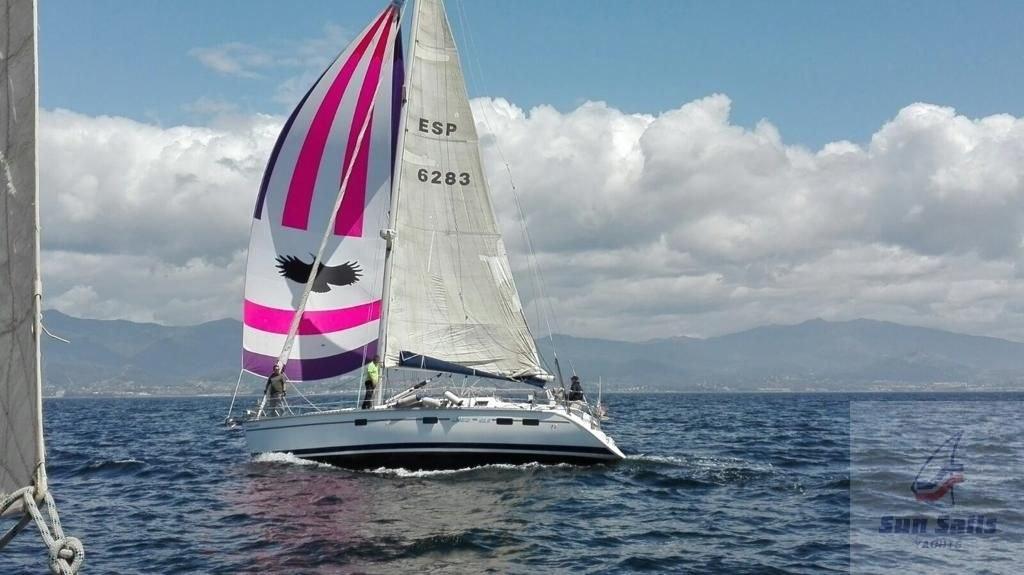
At one point during our trip, the breeze picked up and we responded by easily tensioning the halyards of the mainsail and staysail without leaving the cockpit. We also set up the boat's asymmetrical cruising spinnaker for about an hour to assess the 49's downwind characteristics. With that sail up, the boat responded well, gaining a knot of speed and becoming more stable in the choppy sea.
CONCLUSIONS
The design of the 49 impresses us as much more streamlined than many previous models from this manufacturer. And Hunter has fulfilled most of its self-imposed mandate regarding this boat. This vessel moves significantly towards easier maintenance. For a boat of this size, the H49 is easy to handle under sail. And many elements of the design will enhance safety on the water (the protective panel in the aft cabins, the two watertight bulkheads, and the easy access to the helm head for using the emergency tiller offer strong testimony to that notion).
But the 49 has some shortcomings, primarily its performance in light to moderate air. We did not have the opportunity to test a tall rig version of this boat, nor to sail in more than 16 knots of wind, but our experience indicates that the 49 craves additional sail area in winds of less than 12 knots, particularly when the sea state is choppy. We expect that most owners trying to get from A to B will resort to motor sailing in these situations, which is not an overwhelming disadvantage. We were able to make 9 knots with the mainsheet hard and the iron motor turning at 3,400 rpm. However, since average winds in North American waters tend to be in the 8 to 12 knot range, we would like to have a bit more sail area to work with.
It is evident that Hunter is taking great steps to ensure that this boat lives up to its blue water reputation (Pettengill personally drove the prototype to the beach 10 times at up to 9.5 knots with the mainsail). In our opinion, the 49 offers moderate passagemaking potential with enough comfort and relatively low maintenance to justify its base price of . With some modifications (leeward fabrics for exclusive marine docks, a more robust structure.
Sail Area
I : 54.58 ft
J : 16.50 ft
P : 50.58 ft
E : 21.83 ft
Working Sail Area : 1277.00 sq ft
Keel Details
Keel #1
Keel Type: Fin
Ballast: 11216 lb
Max Draft: 7.00 ft
Description provided by manufacturer
A luxurious passagemaker with a versatile floor plan for total extended offshore cruising, the Hunter 49 offers a complete range of live aboard accommodations and outstanding entertainment features.With an overall length of 49 feet 11 inches , plus a 14 feet 5 inch beam and 6 feet 9 inches of salon headroom, the Hunter 49 is a BIG boat with impressive interior volume. Driving the Hunter 49's new hull is a specially engineered sail plan that achieves maximum efficiency while maintaining the Hunter trademark of single-handed sail-ability, which is a great feature for a boat of this size. Components aboard the Hunter 49 include Hunter's famous mainsheet traveler arch, backstayless B & R rig, a battened full roach main sail, and two headsail options: single self-tacking jib or self-tacking staysail with overlapping jib. A dual-ended mainsheet allows adjustments from both the cockpit and companionway, and all sheets and halyards end at the cockpit.
Pedro
The Company presents the information of this vessel in good faith
Presented For Sale By:
Presented For Sale By:
Services
- InsuranceInsurance