Pacific Seacraft 34
Contact Seller
XPresented For Sale By:
Marotta Yachts of Sausalito
United States
| Make | Pacific Seacraft |
|---|---|
| Model | 34 |
| Year | 1992 |
| Condition | Used |
| Price | US$75,000 |
| Fractional Shares | 1 |
| Type | Sail |
| Class | Cruiser (Sail) |
| Length | 34 ft / 10.36 m |
| Fuel Type | Diesel |
| Hull Material | Fibreglass |
| Location | Sausalito, California, United States |
| LOA | 34 ft 1 in / 10.39 m |
|---|---|
| Length at Water Line | 26 ft 2 in / 7.98 m |
| Beam | 10 ft / 3.05 m |
| Min. Draft | 4 ft 11 in / 1.5 m |
| Displacement | 13200 lb |
| Ballast | 4800 lb |
| Cabin Headroom | 6 ft 3 in / 1.91 m |
| Engine Type | Inboard |
|---|---|
| Engine Make | Yanmar |
| Engine Model | 3HM35F |
| Fuel Type | Diesel |
| Engine Year | 1992 |
| Power | 35 hp |
| Drive Type | Shaft Drive |
| Engine Location | enums.engine-location.center |
| Propeller Type | 3 Blade |
| Propeller Material | Bronze |
| Engine usage (hours) | 2769 |
| Builder | Pacific Seacraft |
|---|---|
| Fuel Tanks | 38 gal |
| Fresh Water Tanks | 75 gal |
| Holding Tanks | 16 gal |
| Hull Shape | Displacement |
Description
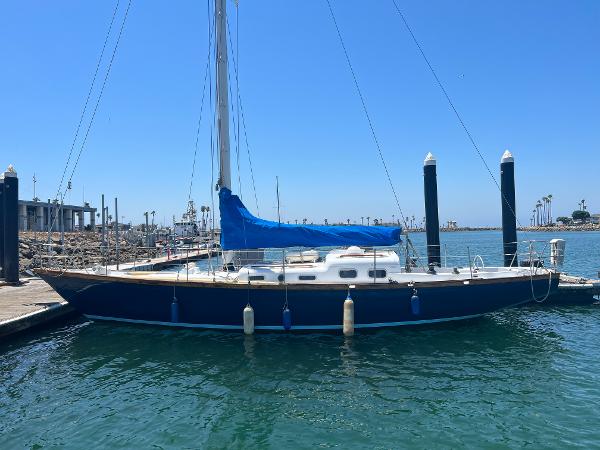
Of the classic Bill Crealock-designed Pacific Seacraft 34 Practical Sailor notes, "...the design's notable for its clean lines, traditional ocean cruiser appearance, and canoe stern. In profile, both have gentle sheer lines and the coachroofs are flat and the bronze opening portlights dominate the cabin sides. She boasts a good turn of speed thanks to moderate displacement and a split underbody, and a relatively narrow beam makes for a seakindly motion".
This particular example has only had two owners since new, is in fine shape inside and out (with the engine just serviced and brightwork gleaming), and is very competitively priced.
Accommodations and Layout
Large V berth with insert berth forward with head next aft to port across from shelving. Step aft to salon with straight settees port and starbord with a double drop leaf table centerline; each setee has a bookshelf and cabinet storage behind it and the port settee easily converts to a comfortable double berth.
Continue aft to U shaped galley port side, centerline companionway with standing nav table and quarter berth starboard.
Note the interior shows very nicely with the lovely dark green cushions contrast nicely with the reddish teak, oversize bronze portholes, grab rails everywhere, teak & holly sole, 6' 2 headroom.
Galley and Head
Twin stainless steel deep sinks with hot/cold pressure water and manual fresh and salt water foot pumps, Force 10 two burner propane stove with oven, large icebox. Groco manual pump toilet.
Electrical
110V AC / 12V DC. Thirty amp shore power service, two Group 31 AGM 12V batteries, Xantrex True Charge 20 battery charger, Xantrex battery monitor.
Electronics
Raymarine SL70 Pathfiner radar, Garmin GPS 152 GPS, Autohelm ST 5000 autopilot, Autohelm depth sounder, Autohelm knot meter, Standard Horizon VHF radio, Ritchie magnetic compass.
Sails and Rigging
Cutter rig with LeFiell single spreader aluminum deck-stepped mast with compression post, 1x19 stainless steel standing rigging (reportedly renewed in 2005) with swaged fittings, full batten dacron mainsail on aluminum boom with Schaefer H-Track traveller with mainsheet, two #43 Lewmar self-tailing winches, single #30 ST, single #16 ST, single #8 ST. 110% Jib on Profurl roller furler, staysail also on Profurl roller furler.
Deck and Hull
When you step aboard a Pacific Seacraft, it is obvious why they have the excellent reputation that they do--beginning with the bulletproof hand laid (right here in California!)hull! Then there are the substantial bulwarks with a heavy teak cap rail with the joints are hand fitted with butterfly joints and the stanchions mounted on the bulwarks to resist moisture intrusion into the deck.
The deck hardware is all oversize and is chrome plated solid bronze- nothing but the best! The list goes on and on...
FRP hull with cored decks and skeg-hung rudder, hull color is white with dark green canvas. Stainless steel heavy duty stanchions with double lifelines, stainless steel bow and stern pulpits, stainless steel swim ladder, dodger with grab rails.
35 lb CQR anchor on stainless steel double anchor roller, Muir vertical windlass with chain and line rode, six mooring cleats.
Monitor windvane.
Practical Sailor Review of the Pacific Seacraft 34 and 37
Originally known as the Crealock 34 and 37, this duo can be thought of as performance cruisers plotted somewhere on the continuum between heavy displacement cruisers and light displacement racers. Both have a seakindly motion and a good turn of speed. Now known as Pacific Seacraft Voyagemakers, they are part of a five-boat line ranging in size from 34 to 44 feet. The 37, introduced in 1980, was followed in 1984 by the 34. In this review we wanted to see how the 34 stacks up against its larger stable mate; for more specific information on the 37 see our earlier review of it.
The Company Pacific Seacraft was founded in 1976 by Henry Morschladt and Mike Howarth, who first produced 25-foot daysailers. Like many boatbuilders, the company suffered during the industry downturn of the 1980s, and the business was sold to Singmarine Industries, Ltd., of Hong Kong. It has been owned by an individual investor since 1998.
The company now is managed by Don Kohlmann, a veteran America’s Cup racer and former owner of Ericson Yachts. He said that 1,850 boats have been built and that the current annual production level is “40 to 50 boats.” In addition to Pacific Seacraft models, the company also builds the Flicka and Dana, seaworthy 20- and 24-foot sailboats, and the 38T Fast Trawler.
Design Designer Bill Crealock’s knowledge of sailing goes well beyond the theoretical. Following graduation with a degree in naval architecture from Glasgow University in Scotland, he spent eight years cruising the Atlantic and Pacific oceans aboard sailing yachts. He also served as sailing master on a 105-foot schooner undertaking a scientific expedition for the US Navy.
Eventually settling down on the California coast in 1958, he has since designed boats ranging in size from dinghies to a 100-foot catamaran. His clients have included Excalibur, Islander, Columbia, Westsail and Cabo Rico.
The Pacific Seacraft 34 and 37 are notable for their clean lines, traditional, ocean cruiser appearance, and canoe sterns. In profile, both have gentle sheer lines and fairly low freeboard. The coachroofs are flat and the bronze opening portlights dominate the cabin sides. Both designs are very soft on the eyes.
The keels are long cruising fins integrated with a skeg on which the rudder is hung. This makes for a more maneuverable boat than a full keel or a full keel boat with cutaway forefoot and “Brewer bite,” that is, a chunk removed from the keel forward of the rudder. The canoe stern figures prominently in the design scheme, and is more pointed than the wider, more rounded sterns found on many Taiwan-built double-enders.
“A canoe stern, if carefully designed and given sufficient overhang,” said Crealock, “can be efficient and attractive. When the going gets really tough your stern will probably have to serve as your bow. The combination of a canoe stern, which presents less area to the sea, and high-lift skeg reduces the chance of a broach when sailing downwind in heavy seas.”
“The 34 aimed at the same overall qualities as the 37, but proportionally was given a little more volume to take care of the extra gear which has become standard. Both were aimed at the sailor who knew that if one day he dreamed of cruising afar he had a boat to take him anywhere.”
Crealock and Kohlmann take pride in an award made some years ago by Fortune magazine that, along with the F-15 fighter plane, listed the Crealock 37 as considered one of the 100 best products made in the US. It was the only sailboat on the list. Construction The 34 and 37 have similar laminate schedules. Hulls are solid fiberglass. Following application of an ISO-NPG gelcoat, a 3-ounce layer of chopped strand mat is wetted out with vinylester resin to prevent blistering. Kohlmann said that chopped strand eliminates “the binder in rolled mat that has been identified as a contributor of water-solubles to the gelcoat/skin interface,” a potential cause of blisters.
This layer is followed by 2415 bi-axial roving (24-ounce roving attached to 1.5-ounce mat) laminated with isopthalic polyester resin. Extra layers are added to the chainplate and keel attachment areas, at the rudderstock, and on the centerline. Hull thickness at the bottom is 7/8".
A full-length interior pan is bonded to the hull with bi-axial roving. This structure provides stiffness to the hull and incorporates foundations for berths and other interior “furniture.” There are recesses molded in to accept bulkheads. Bulkheads, cabinetry and shelving are all bonded to the hull so, “there are no floating interior components,” Kohlmann said.
We’ve never been keen on molded pan interiors because they tend to condense moisture, make access to parts of the hull difficult, make for a noisier boat, and severely limit customization, but Pacific Seacraft does a better job with pans than most production builders. Indeed, Pacific Sea-craft boats are probably the most expensive boats one can buy with a molded pan interior.
The tops of the bulkheads are bonded to the underside of the deck with bi-axial roving. To further strengthen the bulkheads, a teak beam is installed along the top of the bulkhead; it is secured with carriage bolts through the beams, tabbing, and the deck. The construction method results in a unitized structure that is unlikely to flex under heavy load.
The hull-deck joint is at the 4" tall bulwark. The 3/8" deck flange overlays the inward oriented 5/16" hull flange and the two are bedded in 3M 5200® and secured with 1/4" stainless steel bolts and backing plates located on 4" centers. Additional structural support is provided by a 13/16" teak caprail bedded in polyurethane and fastened with #10 stainless steel screws on 8" centers. We doubt this joint will leak or deteriorate except in the event of a heavy collision.
The deck is laminated with mat and bi-axial roving and cored with Baltek AL600 balsa core. Areas in which hardware will be mounted are cored with marine grade plywood in place of balsa. Winches, the 31" tall stanchions and other deck hardware are installed over predrilled holes that are sealed with epoxy before the bolts are pushed through; this helps prevent water from penetrating the lamination. All hardware is installed with stainless steel backing plates.
The chainplates are mounted outside the hull for easy inspection. The exterior plates are made of 1/4" x 2" type 304 stainless steel fastened with carriage bolts to 1/8" thick stainless steel plates bedded on the hull interior. Their placement outboard makes for a wider staying base, which is stronger but makes for wider sheeting angles that affect pointing ability. But because most other modern boats of this size generally have a foot or so more beam, the Crealocks end up with about the same sheeting angles as a beamier boat with inboard chainplates.
The lead keel is fastened to a solid fiberglass stub and bedded in epoxy. Stainless steel backing plates bedded in epoxy are placed over each keel bolt, which is secured with nuts locked in epoxy.
The skeg extends below the rudder to protect against damage incurred during grounding or collision with a submerged object. Protection for the propeller and rudder is provided by a steel plate molded into the leading edge of the solid fiberglass skeg. The bottom of the stainless steel rudderstock is secured by a manganese bronze gudgeon through-bolted to the skeg.
Though expensive, we think the company’s production process yields some of the strongest boats in the industry.
On Deck The deck layout and hardware also reflect the boat’s bluewater heritage. The deck’s 18"-wide walkways are easily navigable because the shrouds are attached to outboard chainplates. Combined with long handrails and high lifelines, it is easy to have one hand on the boat in heavy seas.
Both boats have storage in the stern for two propane tanks and a small compartment for a stern anchor and rode. Lazarettes add storage for fenders, dock gear and small sails.
Single-spreader LeFiell aluminum masts are finished with linear polyurethane paint rather than anodizing, which has become less popular due to EPA restrictions. The rig on the 37 is supported by 9/32" 1 x 19 stainless steel wire, the 34 by 1/4" 1 x 19 wire. Running backstays are standard, necessitated by the inner foretay.
The headstay and inner forestay are fitted with Harken furlers.
Six Harken two-speed self-tailing winches manage halyards and sheets led aft to Spinlock rope clutches. Early models had winches mounted on the mast; we prefer the single-handers package, with all running rigging led to the cockpit. This arrangement will be much appreciated when forced to reef in a heavy sea.
The mainsheet traveler is equipped with a Harken ball bearing traveler.
Accommodations The interior layouts are set up for offshore and are attractive. The common denominators are light flowing in through tempered glass to finely crafted and varnished teak woodwork accented by smooth white Formica® and Corian® surfaces. The feeling of openness is enhanced by 6' 4" inches of headroom in the saloon.
The comparatively narrow beams of these boats, plus their canoe sterns, make for interiors smaller than those on the floating condominiums marketed by the industry giants. Competitors offer boats 18"-24" wider and with significantly more volume aft. This additional space allows them to build a second enclosed stateroom, and, in some cases, a second head. The tradeoff—and there are always tradeoffs—is a less seakindly motion.
The 34 has a regular V-berth with an insert that creates a 78" long by 84" wide queen-size berth. Quarterberths located in the stern of both boats are located aft of the chart tables. Though the space on the 34 is more than 7' long, it is only 34" wide and 20" high. Though billed as a double berth, it’s really too tight for two adults. And, because the pillow area doubles as a seat for the navigator, this area may best be used for storage when not being used as a sea berth.
The galley is designed and equipped to cook a Christmas goose. Features include hot and cold pressure water and gimbaled Force 10 stainless steel two-burner propane stove with oven and broiler. Newer boats are equipped with an 8 cubic foot Seafrost BD3 12-volt refrigerator.
By comparison, the 34 has 6' 6" settees to port and starboard; the port settee converts to a 48"-wide double berth. The dining table folds out of the way on the forward bulkhead.
Crealock located the water, fuel and waste tanks in the bow and stern, and amidships under the teak and holly cabin sole. While one normally doesn’t want excess weight in the ends, it hardly can be avoided in a smaller cruising boat.
The heads in each boat are nearly identical, though the larger boat has a compartment that measures 60" on the diagonal. Neither boat has a shower stall, but the inconvenience will be of little consequence to cruisers in warm climates.
The engine compartment has 360-degree access to the Yanmar diesel—that’s rarely seen. The companionway cover lifts to access the front of the engine; a removable panel in the cockpit sole provides access to the aft end of the engine and steering gear in a space large enough for a 6-footer.
The 34 powers smoothly and quietly. With the Yanmar 35-hp. diesel running at 2,000 RPM, she moves at 6-6.5. knots with an 11" x 17" three-blade propeller, consuming only 6/10 of a gallon of fuel per hour. She’s nimble under power, and turns more quickly in tight quarters than a traditional full-keel cruiser.
Disclaimer
The Company offers the details of this vessel in good faith but cannot guarantee or warrant the accuracy of this information nor warrant the condition of the vessel. A buyer should instruct his agents, or his surveyors, to investigate such details as the buyer desires validated. This vessel is offered subject to prior sale, price change, or withdrawal without notice.
Presented For Sale By:
Marotta Yachts of Sausalito
United States
Presented For Sale By:
Marotta Yachts of Sausalito
United States
Services
- InsuranceInsurance