Dorade Log No. 2: like dating Marilyn Munroe
Along with several other crew in training for the Bermuda Race, Boats.com's editor learns some unexpected lessons while sailing for the first time on the iconic Sparkman & Stephens yawl
You learn about a boat quickly when the wind blows above 15 knots, and that’s what happened in St Maarten over four days when several of us had our first sail aboard Dorade. But even before absorbing the dozens of sailing lessons the 82-year-old yawl had to teach us, we quickly discovered that we’d first have to get used to sharing this classic Sparkman & Stephens design every step of the way with the paparazzi.
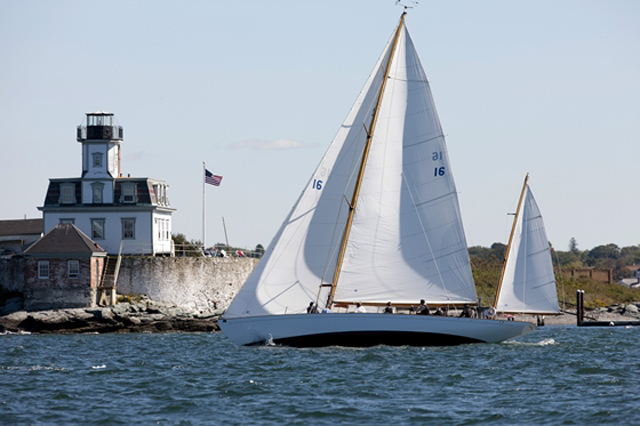
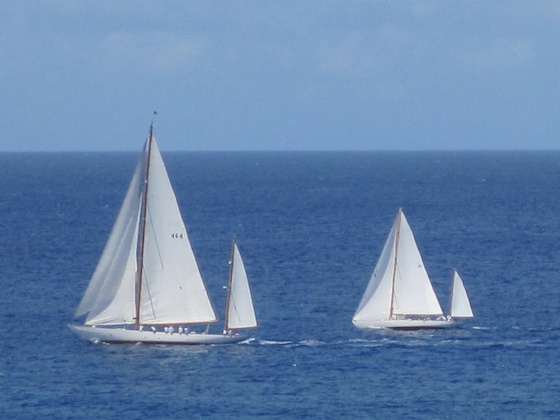
Balanced nicely, Dorade reaches at 9-knots-plus in the Anguilla Channel - photo JAH
Maybe it’s not quite the same as dating Marilyn Monroe, but from the moment we tied up at the St Maarten Yacht Club dock before the 32nd Heineken Regatta, all cameras were trained on our slender 52-foot starlet. As dusk fell, ESPN’s Jo Ankier came down the dock with her crew to interview owner Matt Brooks and skipper Jamie Hilton under the lights on Dorade’s gleaming foredeck. The next day, Friday, Matt and his wife Pam Rorke Levy gave more interviews at the regatta press conference, one of which can be seen on the
&list=UU9o65Rriuj3lDOVJsqPd9rw&index=15&feature=plpp_video" target="_blank">Heineken Regatta YouTube channel.
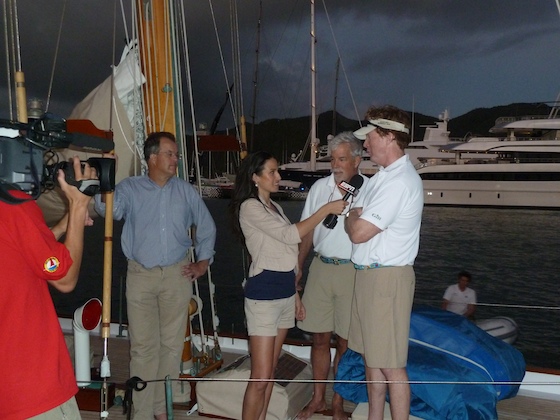
On the eve of the Heineken Regatta, ESPN's Jo Ankier interviews Dorade owner Matt Brooks and skipper Jamie Hilton (right)
After Saturday’s race, while we anchored off Marigot, a camera crew from Martinique motored alongside and shot a short interview on the boat’s history with Greg Stewart, a naval architect in our crew who has worked on technical aspects of the restoration. The crew then stayed aboard for half an hour filming close-ups of Dorade’s immaculate brightwork, her six-foot tiller, skylights, and new Sitka spruce masts.
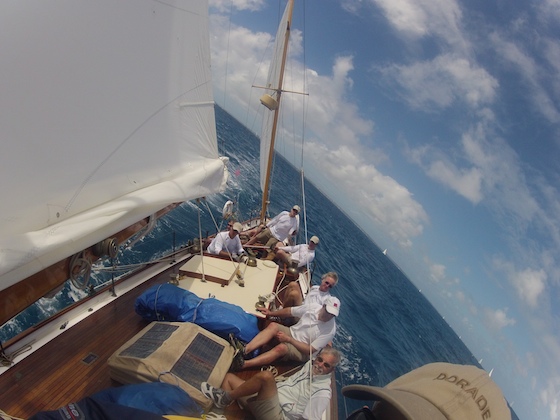
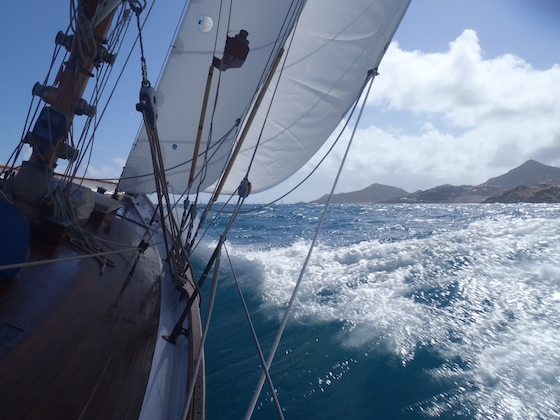
With one reef tucked in the mainsail, Dorade still heels over easily (the camera, mounted on the lower shroud, magnifies the effect)
Finally, at the regatta’s close, there were Jamie, Matt and Pam on camera again with Jo Ankier, discussing the silverware Dorade had just won for us. But it didn’t end there: we were also waylaid at the post-race party by crews from other boats who pulled out their cameras to show off their own snapshots of Dorade as we had sailed nearby them.
While Dorade was looking good all weekend, she taught us plenty of other lessons. We learned how to handle the loads on the halyards, sheets, topping lifts, and running backstays, which tend to multiply on a boat rigged with two masts that can reach with five white sails flying at the same time. We got the hang of reefing and un-reefing the main quickly. We discovered where some re-rigging or beefing up might be required, such as the base for the mizzen sheet winch, which came off the mast with winch and winch handle in my hands at one point.

Greg Stewart remounts the sheet winch for the mizzen
We made some mistakes that we might have got away with in lighter winds, such as leading sheets improperly, or worse, dropping one under the boat with the engine running and fouling it in the prop. (Luckily, this was before our start, and after a relatively quick swim, Jamie cleared it without resorting to his knife.)
Equally important, using four helmsmen and several sail combinations, we collectively began to develop a record of how fast the boat can sail in big waves or small, puffy or steady winds. (More on this in a future post, after we’ve captured a second regatta’s worth of notes.)
Perhaps the number one lesson we picked up was that if we sailed her reasonably well, Dorade will still perform against a younger crowd. But like Marilyn, she has her moods, and most of them can be traced to what she’s wearing and how smoothly her entourage keeps her on the straight and narrow.
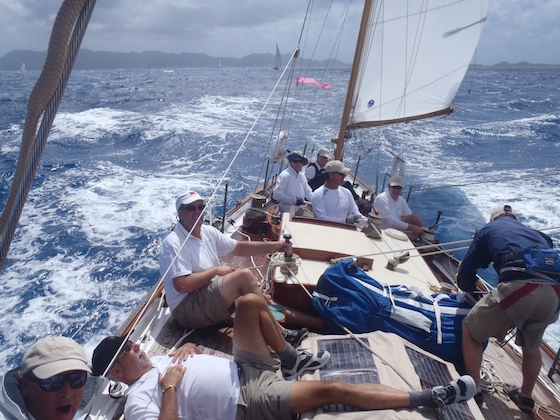
In one race, when I was steering on a reach, I was rewarded with nothing but smiles as her helm was light and we tore across Anguilla Channel at a steady 9 to 9.5 knots, topping out at 10. But later, as we beat along the island to finish at Simpson Bay, she was none too happy when I steered too fine a course in a lull or too deep a course in a puff. In the lulls, she’d slow down to 5.5 knots and challenge me to build back up to 6.75-plus. In the puffs (up to 25 knots or more), she would often put her bow down and charge ahead at 7.5 knots, but heeling over hard, she’d carry a river of white water down her rail and slide to leeward. Hopefully, with practice, I’ll find the groove more often.
To get a sense of what it looks like onboard, we shot a simple video during one race (“
" target="_blank">Dorade: St. Maarten Shakedown”) with a GoPro camera in a waterproof case, hanging on the port lower shroud. Dorade also taught us to minimise manoeuvres. Her tiller’s position in the cockpit limits her ability to turn quickly, widening her turning radius and requiring 25 seconds to complete a tack. On that final beat on Sunday we tacked nine times trying to play the shifts. We gave away plenty of distance to Valerio Bardi’s Swan 46 Milanto, losing the race to her by five seconds on corrected time. We calculated later that given how slowly Dorade tacks and then regains speed, we were losing more than 100 yards with every tack. Perhaps if we’d passed up four of those tacks, we might have saved those five seconds.
We were both surprised and pleased to win our class in the Heineken Regatta, given that this was a full-on training session for five of us who were new to the boat. It helped that Matt and Pam, Greg, and headsail trimmer Nate Burke had sailed two or three regattas each last summer after the restoration work was finished. It also helped that the boat had been well-prepared by recently hired captain Alex Greenson.

Jimmy Lucarelli steers at the finish of the last race...what he dubbed his "Facebook moment"
More than anything, it helped when we didn’t make errors, as on the first day when Jamie steered us around the course and we handled the new asymmetric reaching spinnaker and staysails well. On day two we had a bit of a spinnaker snafu initially but were sailing smoothly and quickly with mainsail trimmer and backup helm Buddy Rego steering, until we lost several minutes changing jibs after ripping out the leech line on a spreader. (As the guy casting off the sheet, I take at least some of the blame for that one.) And on the last day we sailed well again until that final beat.
We finished the weekend stiff and sun-burned from a good workout in the wind. Perhaps our biggest—and most confidence-building lesson—was that we are sailing with a celebrity who is ready to do her job. There are a multitude of small projects and perhaps a few new sails needed to bring out her very best. But the biggest project, no doubt, is getting ourselves in better shape so we can do what’s needed to help her look good when she arrives at the finish line. One thing we now know for sure: Dorade will attract a crowd when she gets there.
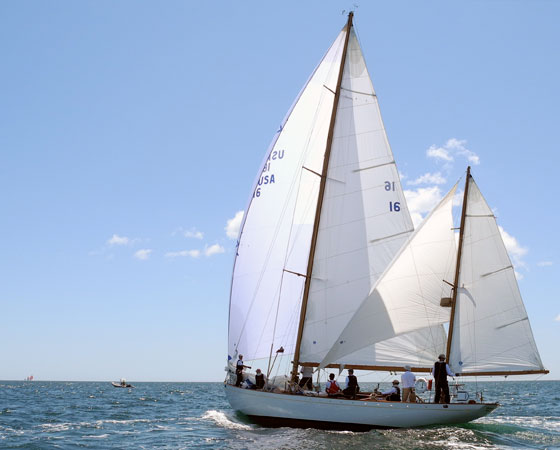
Dorade reaches with twin headsails set en route to winning class in the Round the Island Race.
Read more in Dorade Log No. 1: an iconic classic racer
To learn more about Dorade, you can also visit her own website (every self-respecting celebrity has one, don’t they?).
—John Burnham