Everything you need to know about solar panels on boats: What are they, how to install them, pros and cons
Solar panels are an essential investment for all kinds of boats, offering free and environmentally friendly electricity, even offshore. But how do solar panels on boats work? And how do you install a boat solar panel?
Whether you’re a full-time liveaboard, weekend cruiser, or avid fisher, keeping your boat batteries topped up without needing to run the engine or fuel-hungry generators has always been an issue for boaters, both in terms of energy bills and environmental impact. But there is a solution. As the world increasingly looks to clean, affordable energy solutions, solar technologies for boats have come a long way since our writer, Alex Smith, looked at the topic back in 2013!
Not only has the cost of marine solar panels dropped considerably, but the efficiency of solar energy has massively increased, meaning that you no longer need a fortune or a mega yacht’s worth of space to power a wide range of vessels easily.

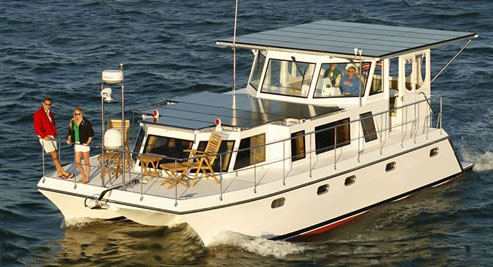
Solar power is a fantastic, environmentally friendly way to power your boat while reducing costs and reliance on shore power. Image credit: PSCopywriting
In fact, it’s pretty rare these days to see any type of boat that doesn’t have a solar panel installed. But choosing the right solar panel for your boat can be easier said than done. The amount of sun you get throughout the day, the angle of your panels, the type of solar panel you select, and even the temperature can affect the productivity of your solar panels, not to mention the added complications of solar regulators and other areas that can reduce how much energy you’re able to generate.
So, before you start shopping for solar panels for your narrow boat, yacht, or even fishing vessel, read on to learn everything you need to know about marine solar panels, including how to calculate your wattage, how to install a solar panel on a boat, the different types of solar panels, and pros and cons of installing your new solar system.
How do solar panels work on boats?
Solar panels on boats work in much the same way as solar panels on land. The first step is getting your solar panel into the sun, where it will convert the energy of sunlight into electricity, which is sent via wires into your solar battery to be stored until the energy is needed.
Generally, solar panels will be used to top-up batteries or banks rather than directly power electronic appliances. This allows solar energy to be stored rather than immediately discharged, allowing you to benefit from the electricity the panels have generated, even after the sun sets.
Although solar panels can have expensive upfront costs, they quickly pay for themselves over time, providing a free source of electricity once installed. Moreover, thanks to the modular design of solar panels, you can add to your set-up over time, allowing you to start small and add more panels to your solar array as your power requirements (and/or budget) increase.
What is a marine solar panel?
Marine solar panels are pretty much identical to other types of solar panels, with the added benefit that they’re incredibly durable and waterproof, allowing them to handle the sometimes harsh conditions of the open sea. Marine solar panels are also specifically designed to work with boats and provide a more off-grid solution, allowing boat owners with sufficient solar panels to power everything on board without returning to shore or resorting to environmentally damaging and carbon-heavy power solutions such as generators.

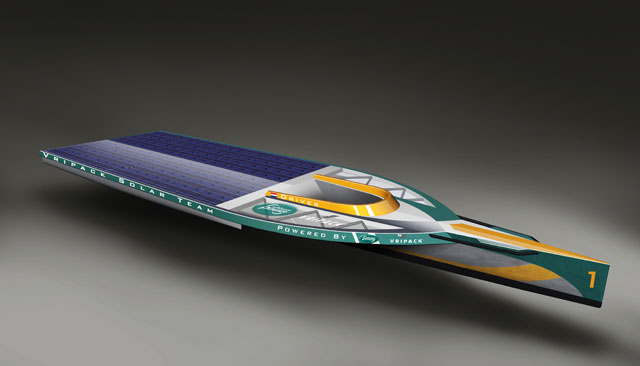
The Swiss catamaran, Planet Solar, takes solar-powered boating to new levels
How much solar do I need for my boat?
If you’re thinking about installing solar panels on your boat, the first thing you’ll need to do is figure out the panel size you’ll need. To do this, you’ll need to know how much energy your boat uses. This might sound intimidating, but it’s not as complicated as it sounds.
Firstly, you need to figure out how many watt-hours each device on your boat uses – for example, if you want your solar panel to charge your fridge, lights, and laptop, you’ll need to know how many watt-hours each device uses.
Most appliances list their energy requirements somewhere on the packaging or the plug, so the tricky part is figuring out how long the appliance will be running. For example, how long does your fridge run? How often do you need to charge your laptop? What happens at night?
Example
A liveaboard catamaran wishes to power their onboard fridge via solar. The fridge is a standard marine 12V system and uses approximately 4 Amps. It will be actively running for approximately 12 hours a day.
To calculate the wattage, you’ll need to multiply the amps by the volts by the hours. So, 4A x 12V x 12hr = 576 Wh.
You’ll then need to allow for discharge, so you’ll need to add on approximately 10-20%. In this example, you’d need at least a 700 Wh solar panel to power the fridge.
If you want to add more devices and become more self-sufficient, you’ll need to do this calculation for everything you want the solar panel to power, adding to that 576 Wh until you have the total energy requirements for your vessel. And don’t forget to add the 20%!
Types of solar panels for boats
Although solar panels have come a long way in recent years, the three main types of panels refer to the solar panel’s construction and haven’t changed. Options for a solar-powered boat include monocrystalline, polycrystalline, and amorphous panels:

Monocrystalline and polycrystalline solar panels are solid panels which will need to be mounted to a frame on a yacht or other type of vessel. Image credit: PSCopywriting
Monocrystalline solar panels
Monocrystalline solar panels are the original and most popular type of panel. As the name suggests, they’re made from single, thin slices of crystal silicone, which are then housed in a rigid aluminium frame covered with tempered and shatterproof glass. This allows them to be durable even in harsh conditions (although they can crack or break under extreme abuse).
With a conversion efficiency of around 17%, monocrystalline solar panels are the best for efficiency and offer the highest electrical output per area. The trade-off is that they’re usually the most expensive and require permanent housing somewhere they won’t be trodden on.
Polycrystalline solar panels
Like monocrystalline solar panels, polycrystalline panels are made from fragments of crystal silicone melted together to form a single piece. This can often give them a shattered glass appearance. While their energy conversion is slightly lower (around 14%), they’re also less expensive than their single-cell alternative.
Amorphous solar panels
Amorphous solar panels are the least efficient option, although they are getting better with advancements in technology. They’re built by placing a thin slice of active silicon on a solid or flexible backing sandwiched between rubber and polymer covers, allowing them enough toughness to be walked on. In some cases, amorphous solar panels can even be rolled up for storage when not in use.
Although they’re not considered very efficient, amorphous solar panels do have an advantage if shade is an issue – while crystalline panels can have an entire module halted with even the thin shadow of a rope, amorphous panels have intelligent ‘bypass’ diodes that turn off shaded cells and create new pathways around them (note: some monocrystalline solar panels also offer bypass diodes, but these come at an increase in cost), so you don’t lose as much energy in the shade.
Further, newer amorphous solar panels have a three-layer construction that allows them to absorb different colours of the solar spectrum. This means that the panel can work harder in lower light conditions than the other types of solar panels, allowing it to deliver more power longer each day.
These features may mean that an amorphous construction may be the best option for canal boat solar panels:
· They’re flexible, so they can rest on the slightly curved roof of a Dutch barge or narrowboat
· They’re strong enough to be walked on
· They produce more energy in shady or low-light conditions, so you don’t need to worry about losing power if you've got a shady mooring.
Flexible vs solid marine solar panels
While considering the different types of solar panels for your boat, it’s also worth considering whether a flexible or solid solar panel would be best. Generally, yacht solar panels will have a solid construction mounted to a solar arch. Mine is held above the dinghy davits, high enough that shade from the mast and rigging isn’t an issue.
On the other hand, canal boat solar panels might need to be walked on or flexible enough to handle the curves of the roof. Fans of YouTube sailors La Vagabond might notice that they have flexible solar panels on their trimaran that can be stored in a locker in high winds or when not in use, offering a valuable boost to their other, more permanent, environmentally friendly energy solutions.
Flexible
As the name suggests, flexible marine solar panels can curve and flex, making them perfect for fitting around the contours of a boat and allowing them to take up less space than a solid, mounted system. Many flexible solar panels are also durable enough to be stepped on. However, you’ll need to ensure they have a non-slip coating, especially when using solar panels in a marine environment!
Flexible solar panels are amorphous, so they do have the downside of a lower efficiency rating of around 7-13% compared to 18-22% available with more modern, monocrystalline panels, meaning that you’ll need to cover a larger surface area to gain the same power output as with a non-flexible panel.
Flexible panels are also the most lightweight option, making them conveniently portable if you’re not constantly aboard and don’t want to leave your panels out all day.

Flexible solar panels are able to curve to the contours of a boat’s hull or cabin top and may be strong enough to walk on. These panels (image credit: @coastal_plodder) can be folded into a briefcase for convenient storage and portability.
Solid
Solid marine solar panels are probably more common, especially with yachts and other sailing boats. Although their rigid structure means they need a permanent frame and are bulkier than amorphous panels, they’re also more efficient, so you can get more power out of a smaller panel. By mounting them in the correct location, you may also find they take up less usable space, as you can mount them above head height in otherwise ‘wasted’ space. Not only does this help reduce clutter on deck, but a higher location can also help prevent shading that can dramatically reduce the power outlet of a mono- or polycrystalline solar panel.
How to install solar panels on a boat
Installing a solar panel on a boat can sound daunting, but it’s actually a lot more straightforward than it might appear. The hardest part is deciding where to put your solar panel; as all boaters know, space (especially deck space) can be precious even on large vessels, so this may take some planning.
On my sailing yacht, I’ve got a solid, monocrystalline panel installed on a metal frame above the dingy davits. Solar panels on narrowboats are likely to be flexible panels that can fit to the contours of the large upper deck space. Catamarans may have a combination of solid and flexible solar panels on the hardtop or the port and starboard hulls. It’s all about the space you have available and the type of panel you’re going for.
It's worth remembering that some solar panels can be walked on, so this can be a benefit if deck space is at a premium. Just be sure to check any panels you intend to walk on have a non-slip coating and any connectors aren’t tripping hazards – especially if you’re looking for solar at sea!
How to hook up a solar panel to a boat battery
Once you’ve found the perfect spot for sailing solar panels, it’s time to get it hooked to your boat batteries. You should have already decided whether your solar panels are meant to float-charge a single battery or be part of a large vessel energy plan (which will dictate the size and number of solar panels you need), so at this point, it should be a straightforward process of hooking up the energy source to the energy storage (not as tricky as it sounds, trust me).

Connecting solar panels to a boat battery sounds intimidating, but it’s much easier than you might expect.
Step One: Wires
The first step in connecting your solar panels to your boat battery is to determine the gauge (size) of the wiring you need to use. Experts recommend multiplying the rated amp output of your solar panel by at least 1.25 (which gives a 25% safety factor) to establish how much energy the wires need to be capable of handling.
Next, you’ll need to measure the length of the wires. Make sure you measure the total length from panel to battery, then double it to ensure you have plenty of space (remember to incorporate all the twists and turns your wires will inevitably have to go through to get from the solar panel to boat battery). The longer the cable needs to be, the more energy will be lost as it travels towards your battery, so you may have to reposition your solar panels or battery to keep the wires as short as possible.
Finally, you need to know your voltage. In the UK, DC marine systems usually operate on a 12V system, so the likelihood is that your solar panels and boat battery will be 12V (see our article on marine electrics: the basics of 12V systems for more details on this). If your solar panels and boat battery operate at different voltages, you’ll need to do some additional work to ensure the energy transfers safely, but that would be an entire article in itself, so I won’t go into it here. Speak to a marine electrician if you need to deal with this.
Once you know the amps, voltage, and distance, you can use an online calculator to figure out how thick your wires need to be to carry the energy efficiently and safely from your boat solar panels to the battery. I did a quick Google search for “wire gauge calculator UK” and found many options.
It’s worth noting that AWG refers to American Wire Gauge. SWG is Standard Wire Gauge and was more commonly used in the UK before we moved to simply measuring wires in mm. AWG ratings run low-high, which means that the smaller an AMG gauge number is, the larger it is in mm, and a large AMG number refers to a very small wire in mm.
Always use high-quality, marine-grade connectors and tinned, multi-stranded copper wires with vinyl sheathing for safety in a marine environment. If the wires will be exposed at any point (for example, travelling along an external deck or cabin house), be sure to use an appropriately weatherproof deck fitting to avoid leaks!
Step Two: Charge controller
Once you’ve got your wires ready, the next thing you’ll need is a charge controller. A charge controller regulates the energy (charge) going into your boat batteries and prevents any overcharging, which will damage the battery. It also prevents reverse current flow when there’s no sun powering your solar panels.
On a boat, the charge controller should be mounted as close to the battery as possible and always below deck. The manufacturer will provide instructions on how to install the charge controller, which you must be careful to follow.
In general, however, you’ll need to connect the solar panel’s positive (red) cable to the charge controller’s positive input terminal and the negative (black) wire to the controller’s negative terminal. Once you’ve done this, you can connect the charge controller’s negative cable to the battery’s negative terminal, followed by the controller’s positive wire to the battery’s positive terminal, via an appropriately sized in-line fuse or circuit breaker.
To repeat, the charge controller should be installed as close to the batteries as possible, and you should always follow the manufacturer’s instructions for installation.

Victron is generally considered to be the best solar charge controller for boats. Image credit: PSCopywriting
Step Three: Waterproofing
Obviously, boats get wet. And water and electricity do not go together! Therefore, ensuring all your connections between your boat solar panels and batteries are fully waterproof and any loose wires are safely secured is essential. Don’t forget to add weatherproof deck fittings anywhere your cables run indoors/outdoors!
Do I need a marine solar panel regulator?
A marine solar panel regulator is another word for a charge controller (also known as a solar controller). Its main job is to prevent your battery from overcharging and getting damaged, and it also stops energy from flowing the wrong way when there’s no sun charging your panels.
There are two types of marine solar regulators: PWM (or pulse with modulation) and MPPT (maximum power point tracking).
MPPT regulators are the more efficient of the two, so they allow your boat's solar panels to deliver more power. However, PWM regulators are easier to use/install, and they’re also the cheaper option.
Do marine solar panels lose efficiency?
When manufacturers claim the wattage for their solar panels, shoppers should remember that this is only the expected output under test conditions and may not be what you’ll get in the real world. Test conditions for solar panels are usually isolated at 1,000W/m2 at a consistent temperature of 25°C. However, in the real world, we know that temperatures are not consistent, and as the sun moves throughout the day, the amount of solar actually hitting your panels will vary, which will, in turn, affect the efficiency of your boat solar panels.
In addition, any shading or scattering from dust, salt, haze, or cloud will reduce the amount of solar energy your panels can absorb. Even if your boat solar panel features bypass diodes, any shade covering even part of your panels will reduce how much energy it's able to generate, so it’s important to keep your solar panels clean and clear of obstructions.
Believe it or not, latitude and temperature can also affect the performance of your solar panels. While you might think that high temperatures would be better for your panels, heat actually reduces the output of a solar panel by about 5% for every 10°C increase in temperature. So, you might actually get a better output in cooler northern latitudes than you would at the equator!
How else can my boat solar panels lose efficiency?
In addition to the obvious ‘how much sun is my solar-powered boat getting?’, there are a few other ways solar panels on boats can lose efficiency that you should check, particularly when installing the solar panels.
Cables
As we’ve already discussed, the cables running from your solar panels to the boat batteries are a potential source of energy loss. If your cables are too long or thin, for example, they will lose some of the charge as the energy travels along the wire.
You can reduce loss by calculating your amps, voltage, and distance with an online calculator using our tips above. From here, you’ll be able to ensure you buy wires that are thick enough to carry the energy safely and efficiently, reducing loss.
Shading
Shading is probably the biggest problem when it comes to solar panels on boats. Masts, ropes, cabins, spray hoods, etc., are all potential shady spots, which will reduce the amount of sun your solar panel can harness. In fact, with most crystalline panels, any shadow hitting any cell on the panel will cause the entire panel to stop being able to produce energy.
So, take time to position your boat solar panel somewhere it will get the most sunlight and is the least likely to struggle with shadows. On our yacht, solar panels are mounted above the dingy davits in a nice high position, reducing the risk of shadows ruining our output.
If you can’t find a shadow-free spot for your marine solar panels, you may want to consider a flexible solar panel or pay extra for a crystalline panel with bypass diodes. Although this won’t completely fix the problem, it does mean that the panel will be able to continue producing energy even if you can’t avoid the odd shadow.

Even a small shadow can dramatically reduce the performance of your solar panels, so it’s important to mount them somewhere where they’ll receive the most sunlight. Image credit: PSCopywriting
Regulator
Regulators, or marine charge controllers, are essential for any boat solar panel setup. This device ensures that too much energy isn’t able to enter your batteries and damage them and stops energy from running the wrong way down the cables when your solar panels aren’t producing energy.
The amount of power the regulator/charge controller allows to pass will depend on how much energy your boat is using. For example, if you’re powering your lights, fridge, and laptop via solar panels, the regulator will allow more power to flow through than if you turn everything off.
Remember that, as far as your solar panel is concerned, the regulator is also a user of power. So, when measuring the voltage and current being generated by your panels, you should look at the entrance to the regulator, not the battery.
‘Charge controller confliction’
The final, often overlooked, place you may lose solar efficiency is when your boat has multiple charging sources, for example – a wind turbine and a solar panel. This is known as “charge controller confliction” and is an issue when the regulator for your solar panel and other energy sources are internally adjusted to the same maximum charge. This causes the different energy sources to effectively fight to be the dominant power source, resulting in poorer overall charge output and performance.
Where should I put my boat solar panels?
As previously mentioned, boat solar panels should be mounted somewhere free from shadows with access to the most sunlight possible. It’s crucial to ensure that your marine solar panels don’t interfere with the vessel’s operation or the movement of the crew.
Flexible solar panels are often strong enough to stand on, but if you intend to do this, ensure the solar panel has a non-slip coating and check that any connectors can’t easily be kicked out or tripped over.
Although solid solar panels might seem to be at a disadvantage, it’s worth considering mounting them to a movable bracket. Although this takes a bit more effort, it means that you can actively twist the solar panel throughout the day to ensure it’s receiving the most possible sunlight that can be converted into energy for your electric boat.

Considering the best place for your solar panels is almost as important as choosing the right ones. You need to pick a space that’s free from shade and not too far away from your battery that you’ll lose power from the cables. Installing solar panels at a slight angle will also allow water to run off. Image credit: @followintrepidbear
Pros and Cons of solar panels for boats
You don’t need to be building a fully electric boat to benefit from solar panels… Whether you’re plugged permanently into shore power or heading out into open water, solar panels are a fantastic and environmentally friendly way to keep your batteries topped up and your electronics running smoothly.
Even if you only have small solar panels, the ability to recharge a dead battery in an emergency, for example, to use a VHF radio, navigation panel, or even just an anchor light, should never be understated.
Pros | Cons |
| Maintenance – Once installed, solar panels require minimum maintenance. Simply wipe the surface with a damp cloth now and then to clear the debris, and you should be good to go! | Expensive – Installing solar panels can be expensive by the time you factor in the price of the panels themselves, the charge controller, cables, and possibly an inverter to transform the energy into something more appliances can actually use. In some cases, you may need to hire an electrician to help hook up solar panels to a boat battery. |
| Longevity – Most solar panels can last 25 years or more before they start to lose efficiency, so your investment will last. | Complicated – Figuring out the wire gauge or amperes your solar panels need, for example, can be complicated if maths isn’t your thing. That said, plenty of online resources can help with this. |
| Engine – Using your solar panels means you won’t need to run the engine every time your batteries need topping up, protecting the engine and helping it last longer. | Longevity – Although monocrystalline panels can last 25 years or more, amorphous solar panels don’t offer anywhere near this, and may start to lose efficiency after just three to five years. So, although they’re cheaper, you may want to invest in something with a longer lifespan! |
| Batteries – Similarly, solar charge controllers help protect your batteries, preventing them from going flat or overcharging, either of which can damage the battery (see also, is my boat battery installation safe?) | Location – Space on yachts and powerboats alike can be hard to come by, so finding a good location for your boat's solar panels that won’t interfere with the operation of the vessel or safety of the crew whilst also providing optimum opportunity to absorb sunlight can be a challenge. |
| Silent – While most energy-generating activities on boats are incredibly noisy, solar panels are completely noiseless, perfect for when you’re in a quiet anchorage and don’t want to disturb the other silent yachts enjoying the peace and quiet. | |
| Environment – Solar panels produce 100% clean, efficient, green energy. By harnessing the sun's energy, you’ll be powering your devices while actively reducing your carbon footprint, helping protect our planet for future generations. | |
| Emergencies – Knowing you have an energy source that operates off-grid can be essential in an emergency. Even if you only get a small panel, being able to use your lights, VHF radio, and chart plotter could be the difference between life and death offshore. |