5 of the best hovercraft
Alex Smith hunts down five recreational hovercraft for those in search of a bum-friendly boating experience.
The core principles of the hovercraft are disarmingly simple. You start with a buoyant hull fitted with a series of flexible skirts. An engine (or pair of engines) is then hooked up to rotors in order to divert air down into the skirts and generate lift. They also push air aft, past a large rudder (or rudders) to produce forward movement and directional control. What all of this creates is a non-displacement platform that is able to replace the jarring impacts of a conventional boat with the yielding softness of an air cushion. It also means that the handling is defined not by the carved control of direct contact between hull and water but by the extravagant slides that come from channelling the direction of the air.
Now while the models of old were often noisy, heavy, cramped, underpowered, limited in range, stylistically inept and robustly unsophisticated, the last 15 years have seen some marked improvements. Better materials have produced reductions in weight and increases in internal space; more advanced engines have generated surges in power, refinement and efficiency; and greater commercial viability has encouraged slicker designs, cleaner build quality, higher grade fixtures and (in some cases) more sophisticated driver interfaces. While plenty of commercial models could now happily double as leisure craft (not least, the aluminium 380TD from Griffon) the following five leisure boats look particularly well suited to family recreation...
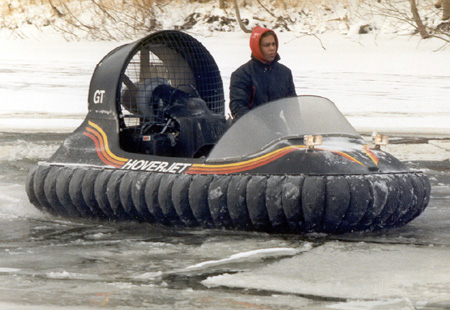
Hoverjet GT.
(1) Hovertechnics Hoverjet GT
At under 11 feet and less than 2,500 kg, this compact, 60hp, two-stroke model is capable of speeds of up to 35 knots on calm water. It will handle waves of up to two feet and while a maximum hover height of 20cm means its obstacle clearance isn’t huge, it comes with a pair of replaceable, hardened aluminium skid rails on the underside of the hull for extra protection. A second (optional) fuel tank would be a useful addition to the base 23-litre unit and the extended screen, extra grab handles, nav lights and horn also look like worthwhile investments. Of course, this agile little boat only has a payload of 180kg but for greater capacity, the well established HoverStar or HoverTour 700 are also worth a look. With proven expertise in the design and manufacture of rescue and commercial grade products, it’s a boat that might just warrant a place in your shed or (with the optional lifting eyes) in your tender garage. See Hovertechnics.
BHC Coastal PRO.
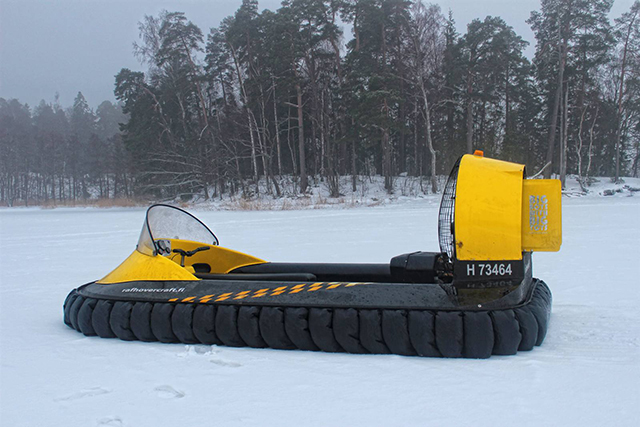
(2) British Hovercraft Company Coastal Pro II
Originally founded as Flying Fish, the British Hovercraft Company, based in Sandwich, Kent, produces four base platforms – the rapid, entry-level, one-man Snapper; the best-selling three-seat Marlin III; the twin-engined four-seat Coastal Pro; and the five-seat, cabin-equipped commercial BBV500. I’ve driven (and enjoyed) the Marlin II but for family fun, the semi-commercial Coastal Pro is a very fine option. This good-looking fibreglass 14-footer is designed for easy low speed control, high load carrying capacity and impressively low noise levels. In fact with a larger, less rapid thrust fan, the builders describe it as “probably” the quietest production hovercraft in Europe. With the Vanguard V-twin 37hp thrust engine and single-cylinder B&S 17.5hp lift engine as standard, you can expect 25cm of lift, plus a top end of around 35 knots. The optional 50hp Rampage engine is also on hand for more demanding roles but with the standard fit-out, the 35-litre removable tank will buy you a range of up to 100 miles.
Hov Pod SPX.
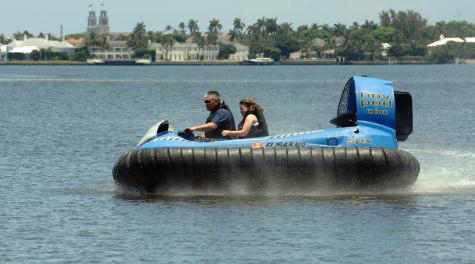
(3) Hov Pod SPX
Unlike most modern hovercraft companies who are keen to pare back every part of the boat that increases weight, Hampshire-based Hov Pod has made a calculated compromise by building its hulls from high-density polyethylene. While it is heavier than fibreglass, it is also much tougher, more impact resistant and easier to repair. It is also inherently buoyant, which means that the Hov Pod SPX is rated to support more than a metric tonne in weight before water breaches the hull. Even the base 65hp engine will lift a payload of 275kg from a water start and with marine-grade electrical connections and stainless steel fittings throughout, the quality looks good too. High-class engine options from Weber include a single 65hp two-stoke and a 120hp four-stroke for both lift and thrust duties. And the skirts are constructed from a woven polyurethane / nylon fabric designed for better durability and anti-rip properties than conventional neoprene-coated nylon. It’s by no means the cheapest option but it’s certainly one of the best.
Hovertrek 6.
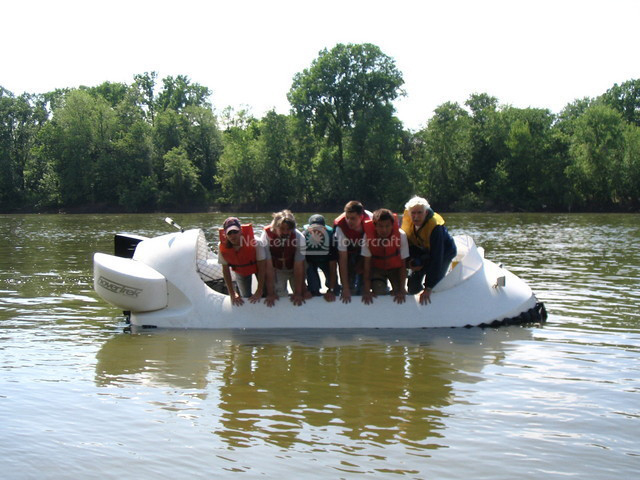
(4) Neoteric Hovertrek 6
Neoteric has spent nearly 50 years building light hovercraft – and that is perfectly evident on its current Hovertrek model. Available either as a four or six-man platform, it boasts a large cockpit space with user-friendly, side-by-side seating, plus the option of a fully enclosed cabin and an active ‘reverse-thrust’ system to aid braking and manoeuverability. In the six-man version (pictured), a payload of up to 466kg means you can enjoy your hovercraft as a family pursuit rather than a lone thrill – and while it’s little more than 15 feet in length, it still offers great stability at rest, even under shifting loads. A remarkably low weight of just 290kg, allied to the dual tank option, brings an impressive cruising range of around 126 miles – and with an extensive client base in 50 countries around the world, plus a huge range of upgrades and customisation routes, this light and refined hovercraft is among the most developed of its kind.
Pacific Slider SLX100.
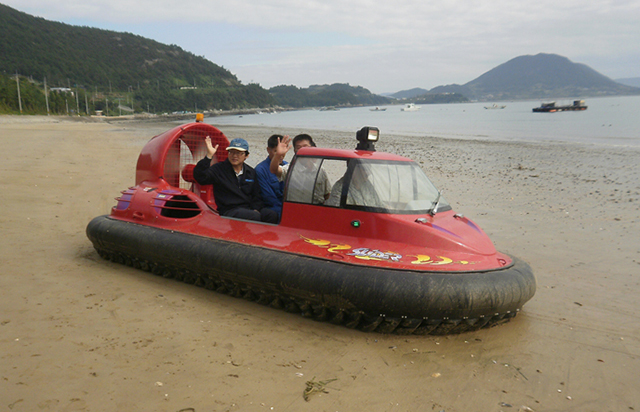
(5) Pacific Slider XLS100
The Sport and its larger sibling, the XL, have been around for a while now, but in the form of the XLS100, the Pacific Slider is aiming to reassert its claimed position as “the most advanced light hovercraft in the world”. Built from fibreglass and weighing around 320kg, this 14-foot boat is equipped with a fairly conventional jockey seat with internal storage, supplemented by extra storage inside the forward fairing. The use of a permanently pressurised skirt makes it very stable at rest and the compact Sauer 100hp engine delivers high torque at low rpm to drive the lift and thrust fans without too much stress. The working parts are positioned aft of the passenger seat and fully enclosed for extra safety and reduced noise and the Kevlar-reinforced fibreglass hull uses a skirt built from 77-segments of nylon-reinforced PVC. With cruising economy of 23 litres per hour, a generous 100-litre tank also means up to four hours of cruising between fills. See Hovercraft New Zealand.
You might be interested to read: Flying Fish Marlin II: an affordable hovercraft.